PlayOJO Verification UK: KYC Documents and Withdrawal Checks
 Available in GB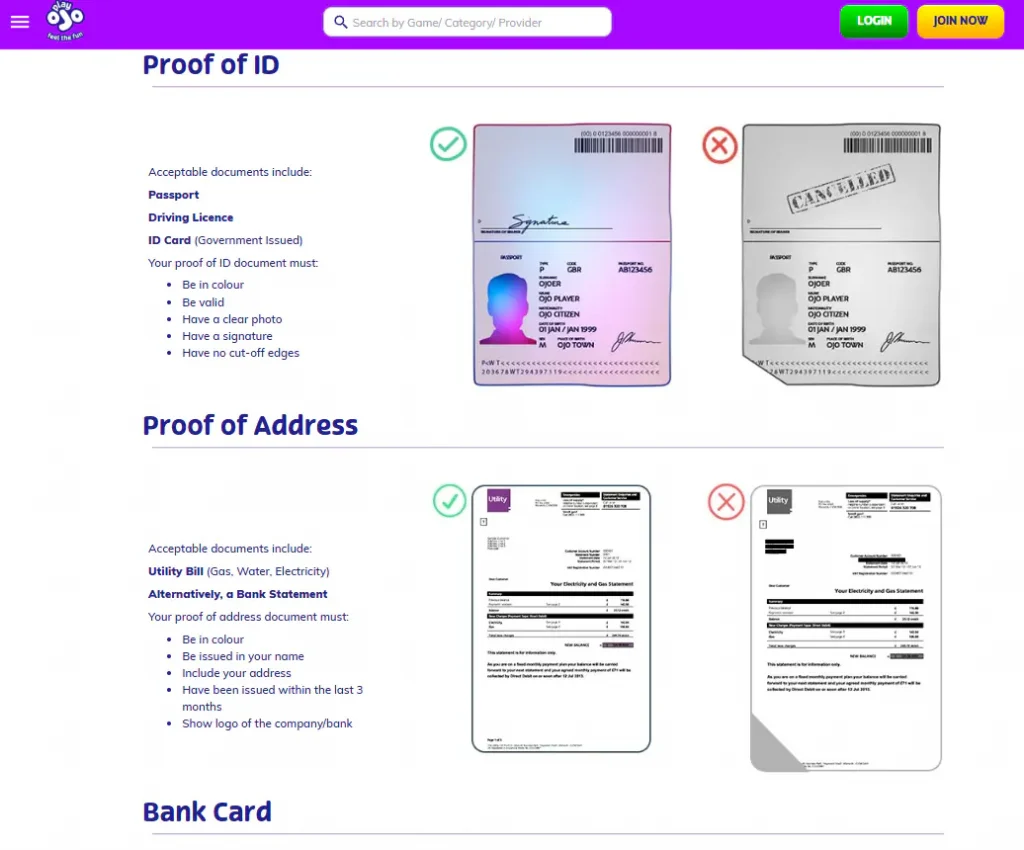
KYC documents and account checks
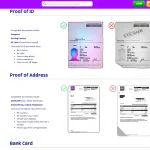
PlayOJO’s current verification guide lists a passport, driving licence or government-issued ID as acceptable proof-of-ID examples, and a utility bill or bank statement as proof-of-address examples. These are document types the brand says it accepts, not a universal checklist that every customer must submit in full. In Great Britain, UK Gambling Commission rules require remote operators to verify core identity information before gambling, while additional evidence should be requested when it is reasonably needed rather than deliberately left until withdrawal. PlayOJO can also ask for evidence connected to a bank card, a new payment method or changed personal information.
Table of Contents
- Current PlayOJO document examples
- Why PlayOJO can ask for verification documents
- Proof of identity: what PlayOJO currently lists
- Proof of address: the current examples and quality rules
- Bank card evidence has its own privacy rule
- How document upload works on the current PlayOJO site
- Verification and withdrawals: what the UKGC rule actually says
- Changed details and new payment methods can trigger another request
- How long does PlayOJO verification take?
- Common reasons a verification upload can create problems
- What not to infer from a KYC request
- How to avoid document problems when PlayOJO asks for verification
Current PlayOJO document examples
| Purpose | Examples PlayOJO currently lists | Important distinction |
|---|---|---|
| Proof of identity | Passport, driving licence, government-issued ID card | Acceptable examples, not evidence that every account must submit every type |
| Proof of address | Utility bill or bank statement | The current page says it must be in the player’s name and show the address |
| Bank card check | Copy of a card used for deposit where PlayOJO requests it | Current guidance says the middle eight digits should be covered |
Why PlayOJO can ask for verification documents
Verification supports the operator’s duty to establish that the account belongs to the person using it. In Great Britain, UKGC Licence Condition 17.1.1 requires remote operators to obtain and verify enough information to establish a customer’s identity before the customer is permitted to gamble. The minimum information includes name, address and date of birth.
The rule does not say that every customer must upload the same bundle of files. An operator can use different verification methods, and documentary evidence becomes relevant when the information cannot be established sufficiently through other checks or when further information is needed. That is why two PlayOJO customers can be asked for different evidence without either experience being inherently abnormal.
The PlayOJO registration covers account opening before documents are involved. Identity, address and payment-method evidence becomes relevant when PlayOJO needs additional information for the account checks.
Proof of identity: what PlayOJO currently lists
PlayOJO’s official upload guide currently names three acceptable proof-of-ID examples: a passport, a driving licence and a government-issued ID card. The same page says the proof-of-ID image should be in colour, the document should be valid, the photo should be clear, the signature should be visible and no edges should be cut off.
These current brand instructions also explain why a technically correct document can still fail as an upload. An expired passport, a cropped licence or a blurred image may not satisfy the quality requirement even when the document category itself is accepted.
Do not submit several unrelated identity files unless the account asks for them. The goal is to satisfy the specific request with a clear accepted document, not to overwhelm the review queue with multiple alternatives.
Proof of address: the current examples and quality rules
For proof of address, PlayOJO currently lists a utility bill for gas, water or electricity, with a bank statement as an alternative. Its guidance says the document should be in colour, be issued in the player’s name, include the address, have been issued within the last three months and show the company or bank logo.
PlayOJO’s current proof-of-address guidance uses a three-month age limit for the listed documents. If the account presents a different requirement later, the account-specific request determines what is needed for that verification case.
The name and address on the evidence should correspond to the account. If you have moved recently, an old statement may be perfectly genuine but still fail to evidence the current address on the player profile. Updating the account through the proper route and then supplying evidence for the current details is cleaner than trying to make two different addresses appear compatible.
Bank card evidence has its own privacy rule
PlayOJO’s current document page says that when a bank card is used for a deposit it can require a copy of that card, and describes this as a once-per-card step unless a new card is used. For the front of the card, the guidance says the first four and last four digits should be visible while the middle eight digits are covered.
That instruction matters because sending an unredacted card image can expose more payment data than the operator asks to see. Follow the current masking requirement rather than assuming a full card number is useful evidence. Also make sure the image has no cut-off edges so the reviewer can see that it is a complete card image rather than a cropped fragment.
If the account asks for payment-method evidence other than a bank card, follow the specific request instead of applying the bank-card masking pattern to a different document type.
How document upload works on the current PlayOJO site
PlayOJO’s current guidance directs customers to the My Account area and the Upload Documents function. The help content describes choosing the document type, selecting the file and uploading it. Those interface labels are current now, but they should not be treated as permanent product architecture because account menus can be redesigned.
The reliable principle is to use the authenticated upload route PlayOJO provides for the account. That keeps the document associated with the correct player profile and avoids sending sensitive ID through an unrelated channel. If the account itself provides a different current route or support instruction, follow that live instruction.
Before uploading, check the file once at full size. Confirm that text is readable, all required edges are visible, the image is in colour where required and there is no glare hiding an important field. A thirty-second quality check can prevent another verification cycle.
Verification and withdrawals: what the UKGC rule actually says
UKGC Licence Condition 17.1.1 says a withdrawal request must not result in a requirement for additional information if the operator could reasonably have requested that information earlier. This is important because basic identity verification should not be deliberately postponed until the player tries to take money out.
The rule also contains an exception: it does not prevent an operator from seeking information that it must obtain at that later time because of another legal obligation. In other words, the regulation is not a promise that no further check can ever occur at withdrawal. It is a requirement not to create avoidable withdrawal friction by delaying predictable requests.
PlayOJO’s own help material says a withdrawal may sometimes involve standard verification documents and that additional documents can be requested where needed. The PlayOJO withdrawals guide explains how that sits alongside current withdrawal methods, method-specific minimums and the brand’s processing claims.
Changed details and new payment methods can trigger another request
PlayOJO’s upload guidance says it can ask for additional documents after a customer uses a new payment method or changes personal information such as address or name. That makes sense from an account-security perspective: the operator needs its identity information to remain accurate and its payment trail to belong to the correct player.
A later request therefore does not necessarily mean the first verification failed. It can mean the underlying facts changed. For example, moving home can make the old proof of address unsuitable for the updated account, while a new bank card can create a new payment-method evidence requirement.
Keeping account information current reduces ambiguity. If a change is legitimate, make it through the account or support process and then provide the evidence requested for the new details rather than leaving the account and documents inconsistent.
How long does PlayOJO verification take?
PlayOJO currently says it checks documents as quickly as possible and that review usually takes less than 12 hours. The same guidance immediately qualifies that estimate by saying extra verification can take longer and suggests contacting the OJO team if there has been no response within 48 hours.
The phrase “usually less than 12 hours” is a current PlayOJO service estimate rather than a guaranteed deadline for every KYC case. A straightforward proof-of-ID upload and a case involving changed details or additional checks can take different amounts of time.
Do not make a time-sensitive withdrawal plan that depends on the optimistic end of the estimate. If verification is outstanding, the most useful action is to make sure the requested evidence is complete and readable, then allow the review to run. If the operator’s own stated follow-up point has passed, contact support with the account details needed to locate the request.
Common reasons a verification upload can create problems
Cropped or unreadable image
PlayOJO’s current ID guidance requires a clear image with no cut-off edges. A valid document can still be unusable if the image hides key information.
Outdated address evidence
The current proof-of-address guidance asks for a recent document in the player’s name showing the address and issuer logo.
Account details do not match
A different spelling, old address or changed payment method can create a legitimate need for more evidence before the operator can reconcile the account.
What not to infer from a KYC request
A request for a document is not, by itself, evidence that an account is in trouble or that a withdrawal will be refused. Verification is a normal part of a regulated remote gambling account, and the type of evidence depends on what still needs to be established.
Likewise, one player’s document request is not a reliable checklist for another player. Public forum posts often turn an individual request into a supposed universal rule. The official PlayOJO list is more useful because it tells you which documents the brand currently accepts, while the account-specific request tells you which of those are relevant to you.
For regulatory context behind these checks, the PlayOJO licence page explains the Great Britain licence position and keeps that separate from the document workflow.
How to avoid document problems when PlayOJO asks for verification
Use the document type PlayOJO asks for, make sure it is current where required, in colour where the guidance requires colour, readable at full size and complete at the edges, and follow the current masking rule for a bank card rather than exposing the full number.
Keep the evidence consistent with the account because a clear document with the wrong address or a payment method that belongs to someone else can create more questions rather than fewer; identity, address and payment evidence should tell the same story.
There is no universal promise that every PlayOJO verification case will finish in the same number of hours, so treat the current timing statement as an estimate, follow any account-specific request and use the operator’s support route if the review goes beyond its stated follow-up window.
For the wider casino overview, return to the full PlayOJO review.
Recommend
PlayOJO Registration UK: Sign-Up, Identity Checks and Account Setup
PlayOJO UK Guide Account opening and identity checksRegistration combines account setup with the age and...
PlayOJO Trust and Licence UK: Operator, UKGC Record and Player Protections
PlayOJO UK Guide Operator record, regulation and practical protectionsThe UK Gambling Commission register links PlayOJO...
PlayOJO Mobile Casino UK: iOS, Android and Browser Play
PlayOJO UK Guide App or browser on UK mobilesPlayOJO can be used through a mobile...
PlayOJO Bonuses and No-Wagering Rewards in the UK
PlayOJO UK Guide UK bonus and rewards guide PlayOJO separates its welcome package, short-term Kickers...

PlayOJO Games UK: Slots, Live Casino and Bingo
PlayOJO UK Guide Game catalogue and providersThe PlayOJO catalogue spans slots, live casino, table games...
PlayOJO Payment Methods UK: Deposits, GBP and Cashier Options
PlayOJO UK Guide Deposits, GBP and cashier choicesUK accounts use GBP and the cashier presents...