PlayOJO Registration UK: Sign-Up, Identity Checks and Account Setup
 Available in GB
Account opening and identity checks
Opening a PlayOJO account is more than filling in a registration form. For customers in Great Britain, UK Gambling Commission rules require a remote operator to verify a customer’s name, address and date of birth before allowing that person to gamble. Age must also be verified before the customer can deposit, use free-to-play gambling games or gamble with money or a bonus. The exact PlayOJO screen sequence can change, but the account journey still has to establish the information required for account opening and identity checks. If PlayOJO cannot complete the required checks automatically, it can ask for supporting documents before or after initial account setup.
Table of Contents
- What matters before you start
- How PlayOJO registration works in practice
- Great Britain age checks happen before deposit or play
- Identity verification is also required before gambling
- What information should be accurate from the start?
- Registration checks and later checks are not the same thing
- Why a withdrawal should not be the first time avoidable ID is requested
- What to do if PlayOJO asks for documents
- Do not plan around a fixed verification time
- Registration mistakes that create avoidable friction
- How licensing context fits the account journey
- What PlayOJO checks before a Great Britain account can start playing
What matters before you start
| Stage | What matters | Why it matters |
|---|---|---|
| Create the account | Enter accurate personal details in the current PlayOJO form | Those details are used for age and identity checks |
| Age check | Age must be verified before depositing, free-to-play gambling access or gambling | This is a Great Britain remote-gambling requirement |
| Identity check | Name, address and date of birth must be verified before gambling | UKGC Licence Condition 17.1.1 sets the minimum identity requirement |
| Extra evidence | PlayOJO may request supporting documents when automated checks are not enough or more information is needed | Document requests are account-specific rather than a universal identical checklist |
How PlayOJO registration works in practice
Registration is an account-opening process with identity checks built into it. Start through PlayOJO’s registration route and enter the information requested there. Individual fields, ordering and interface labels can change, while the underlying purpose remains the same: the operator needs accurate information to establish who is opening the account and whether that person can use the service in Great Britain.
Use your real personal details and keep them consistent with the information held by your bank, payment provider and any identification documents you might later be asked to supply. A mismatch in spelling, date of birth or address can turn a routine automated check into a manual verification problem. Correcting an avoidable mismatch later is usually more work than entering the current information accurately at the start.
Registration should also be kept separate from choosing how to fund the account. Once the account is ready for a deposit, the available routes can be checked in the cashier. The PlayOJO payment methods guide covers the current deposit-side options without mixing payment rules into the sign-up process.
Great Britain age checks happen before deposit or play
The UK Gambling Commission’s remote social responsibility code requires age verification before a customer can deposit funds, access free-to-play versions of gambling games made available by the operator, or gamble using their own money or a free bet or bonus. This is stricter than a model where an operator simply accepts a declared date of birth and checks it later.
That rule explains why a newly created account can exist while some functions remain unavailable until age verification succeeds. Registration and permission to gamble are not the same event. The operator can collect account details first, but the regulatory gate must be cleared before the activities covered by the rule become available.
UK Gambling Commission licensing rules apply to gambling offered to consumers in Great Britain. They should not be extended automatically to Northern Ireland as if the same regulator and statutory framework covered the whole UK in exactly the same way.
Identity verification is also required before gambling
Licence Condition 17.1.1 requires remote licensees to obtain and verify information establishing a customer’s identity before the customer is permitted to gamble. The minimum information includes the customer’s name, address and date of birth. The rule is outcome-based: it specifies what must be established, not one fixed registration interface that every operator has to use.
For the player, the practical point is simple. A successful account creation screen does not by itself prove that every verification step has finished. PlayOJO may be able to check some information without asking you to upload a file, or it may need supporting evidence. If documents are requested, the dedicated PlayOJO verification guide explains the current examples and image-quality requirements published by the brand.
The distinction also helps explain why it is unwise to use invented or approximate data just to get through a form. The operator has to establish that the key identity details belong to the same real person. Information that cannot be matched can create an unnecessary interruption later.
What information should be accurate from the start?
The core regulated identity fields are name, address and date of birth. In practical account setup, those should match the information you can support if PlayOJO later asks for evidence. Additional fields can vary as the operator changes its registration interface.
Address details deserve particular care. If you have recently moved, use the address that is current for the account and that you can evidence if needed. Similarly, enter your legal name rather than a nickname if the account later needs to match a passport, driving licence, bank statement or payment method.
Payment details should also belong to the account holder where required by the operator’s rules. A clean match between the player identity and the payment trail reduces the chance that a later security or withdrawal check has to resolve who owns a particular card, bank account or wallet.
Registration checks and later checks are not the same thing
Early identity verification does not mean the operator is forbidden from ever asking another question. UKGC rules specifically prevent a withdrawal request from being used to demand additional information that the operator could reasonably have requested earlier. However, the same licence condition allows information to be sought later when another legal obligation requires it.
That is why it is useful to separate basic identity verification from later account-specific checks. The first establishes the customer before gambling. Later checks can relate to changed personal details, a new payment method, security concerns or other obligations that arise during the customer relationship. A later request is not automatically evidence that the original account was never verified.
PlayOJO’s current document guidance says it can ask for additional uploads if a customer uses a new payment method or changes personal information such as name or address. Those examples are a better guide to the logic of further checks than assuming every account follows one identical KYC sequence.
Why a withdrawal should not be the first time avoidable ID is requested
UKGC Licence Condition 17.1.1 contains an important consumer-protection rule: a request to withdraw funds must not trigger a requirement for additional information if the operator could reasonably have asked for that information earlier. The Commission has repeatedly highlighted this because historically some players only encountered verification friction when trying to take money out.
This does not mean no withdrawal can ever be checked. It means the operator should not hold back a predictable identity request until the withdrawal stage. If a new legal duty or a genuinely later-arising issue requires more information, further checks can still be legitimate. The practical difference is whether the information could reasonably have been collected sooner.
If your concern is specifically about payout checks, minimums and payment routes rather than registration, use the site’s withdrawal guide instead of treating sign-up and cash-out as the same topic.
What to do if PlayOJO asks for documents
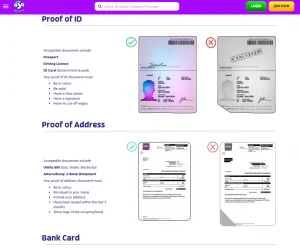
Do not guess what document the account needs. Follow the request shown in the account or sent by PlayOJO and supply the relevant evidence in the requested format. The official document guide currently lists proof-of-ID examples such as a passport, driving licence or government-issued ID, and proof-of-address examples such as a utility bill or bank statement.
Those are examples from PlayOJO’s current guidance, not a promise that every customer must upload all of them. The exact request depends on what the operator still needs to verify. A player whose details are confirmed through other checks can have a different experience from someone whose address, payment method or personal information needs supporting evidence.
When a file is required, make it readable and complete. Cropped edges, unclear images or information that does not match the account can create another round of review. Page 13 covers those image and document requirements in detail so this registration page can stay focused on account setup.
Do not plan around a fixed verification time
PlayOJO’s current document page says it usually checks documents in less than 12 hours, but it also says extra verification can make the process take longer and suggests contacting support if there has been no response within 48 hours. That wording is a service estimate, not a guaranteed KYC deadline.
For account planning, the useful conclusion is not that verification always takes a certain number of hours. It is that document review can be quick when the evidence is straightforward but can take longer when extra work is required. Avoid depositing or planning a time-sensitive withdrawal on the assumption that a document request will always be resolved inside one fixed window.
If a verification request is outstanding, use the upload route or account instructions PlayOJO currently provides and make sure the information matches the account. If the issue persists beyond the guidance shown by the operator, contact support rather than repeatedly uploading different versions of the same document without knowing what failed.
Registration mistakes that create avoidable friction
Using details that do not match ID
A nickname, old address or mistyped birth date can turn a straightforward identity check into a manual mismatch.
Assuming sign-up means verification is finished
An account can be created before every regulated permission is available. Age and identity checks still control when deposit or gambling functions can be used.
Waiting until withdrawal to think about KYC
Keep account details current and respond to reasonable earlier requests instead of treating verification as a cash-out-only task.
How licensing context fits the account journey
The registration rules described here matter because PlayOJO’s Great Britain service operates under a remote casino licence held by Skill On Net Limited. The site-wide PlayOJO licence page explains the current UK Gambling Commission register entry and keeps the licensing claim separate from the account mechanics covered here.
Licensing establishes the regulatory framework, while the registration, payment and verification screens determine the account steps a player actually sees. A licence statement therefore does not determine every operational detail of the account journey.
What PlayOJO checks before a Great Britain account can start playing
The essential checks are not a mystery: age has to be verified before deposit, free-to-play gambling access or gambling, and core identity information including name, address and date of birth must be verified before gambling. PlayOJO can then request supporting evidence where its checks need more information.
For a Great Britain customer, the best preparation is to register with accurate current details, keep payment information consistent with the account, and respond to any document request with the exact evidence requested. That approach is more reliable than trying to memorise a fixed sequence of screens that PlayOJO can redesign at any time. For the broader product overview, return to the PlayOJO UK review.